Competition
Competitors describe PT Sarana Menara Nusantara Tbk.'s market in their own filings and calls. These verified passages and visual pages show where their strategies meet, using source documents preserved in Sources.
PT Tower Bersama Infrastructure Tbk. (TBIG)
The other of Indonesia's 'big two' independent tower companies and Protelindo's most direct competitor — it pursues build-to-suit and colocation tenancies from the same national MNOs (Telkomsel, Indosat, XLSmart). Its filings describe the shared competitive market, a near-identical growth playbook, and the MNO-consolidation dynamic that weighs on both operators' net tenancy adds.
How TBIG frames the market it shares with Protelindo — under a heading 'Indonesia Tower Market Share,' it lists the differentiators that decide tower-leasing wins: location, operator relationships, tower quality, portfolio size and pricing.
The Indonesian tower leasing market is competitive, with key differentiators being tower location, relationships with telecommunications operators, tower quality and height, portfolio size, pricing, operational management, and value-added services.
p. 54 · Read in context →
TBIG's stated growth strategy — build-to-suit construction, tenancy-ratio (colocation) expansion, and portfolio acquisitions from tower companies and operators — mirrors Protelindo's own playbook almost point for point.
Our business growth strategy is comprised of three key components: (i) the construction of additional sites and fiber optic cables on a build-to-suit basis for Indonesian telecommunications operators, (ii) organic growth through expansion of our tenancy ratio, and (iii) growth by acquisition of site portfolios from tower companies and telecommunications operators as well as fiber optic assets.
p. 54 · Read in context →
TBIG's CEO on the FY2025 tenancy slowdown: the XL Axiata–Smartfren merger that formed XLSmart triggered non-renewals of expiring tenancies — the same operator-consolidation pressure that constrains Protelindo's net adds. TBIG closed 2025 with 41,892 tenants and a 1.73x tenancy ratio (reported on the same page).
Hardi Wijaya Liong, CEO of TBIG: For the full year 2025, we added 1,280 gross tenancies, consisting of 797 telecommunication sites and 483 collocations to our portfolio. Following the merger between XL Axiata and Smartfren in March 2025, to form XLSmart, we had some non-renewals on expiring tenancies, which resulted in the lower net tenancy adds for 2025.
p. 5 · Read in context →
PT Dayamitra Telekomunikasi Tbk. (Mitratel) (MTEL)
Telkom's tower arm and the largest tower operator in Indonesia by site count — a direct rival for tower and fiber leasing and for portfolio acquisitions. Its decks contest the very 'largest independent towerco' positioning TOWR claims and quantify a tower- and fiber-wallet-share lead over the other tower providers.
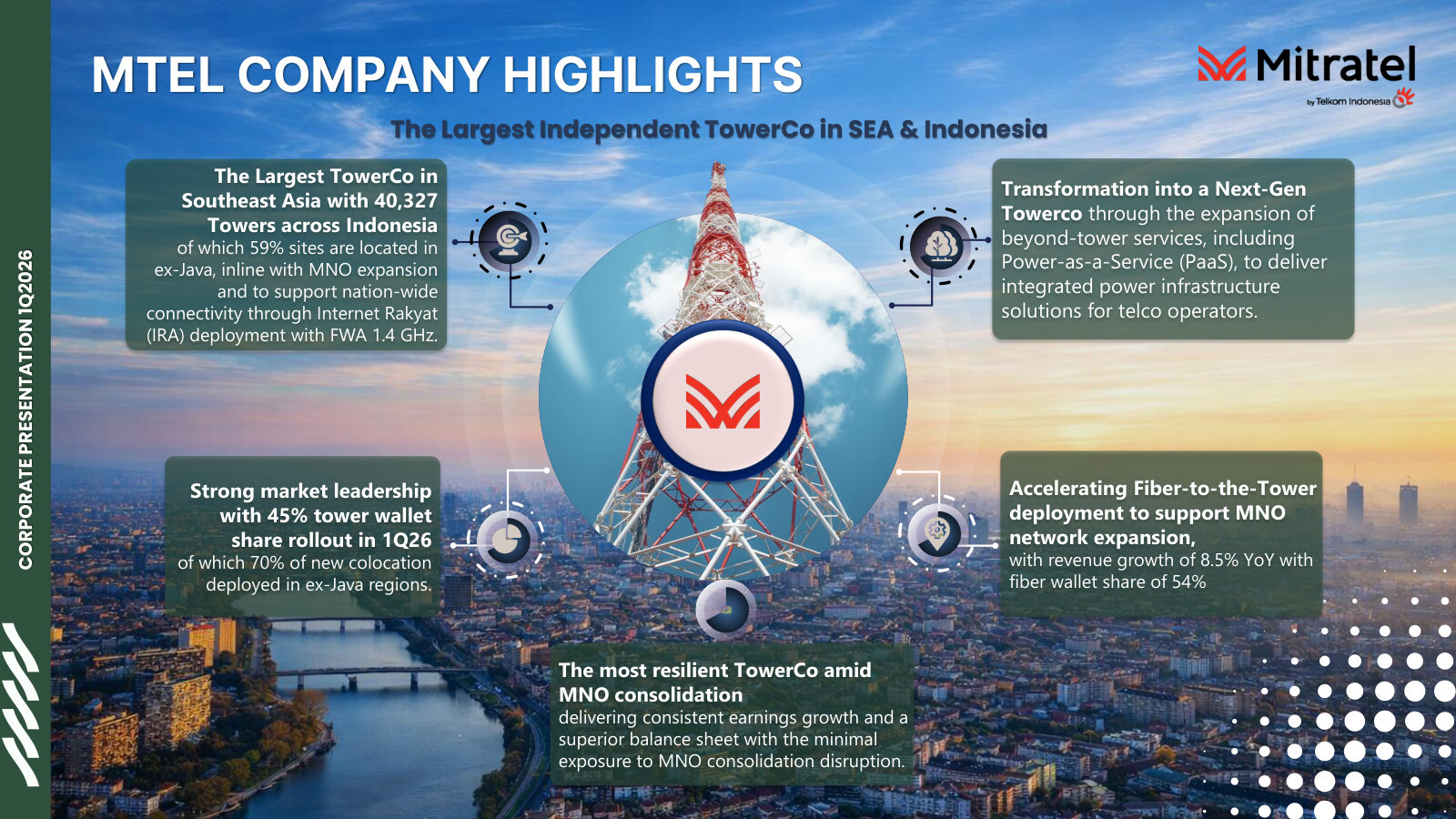
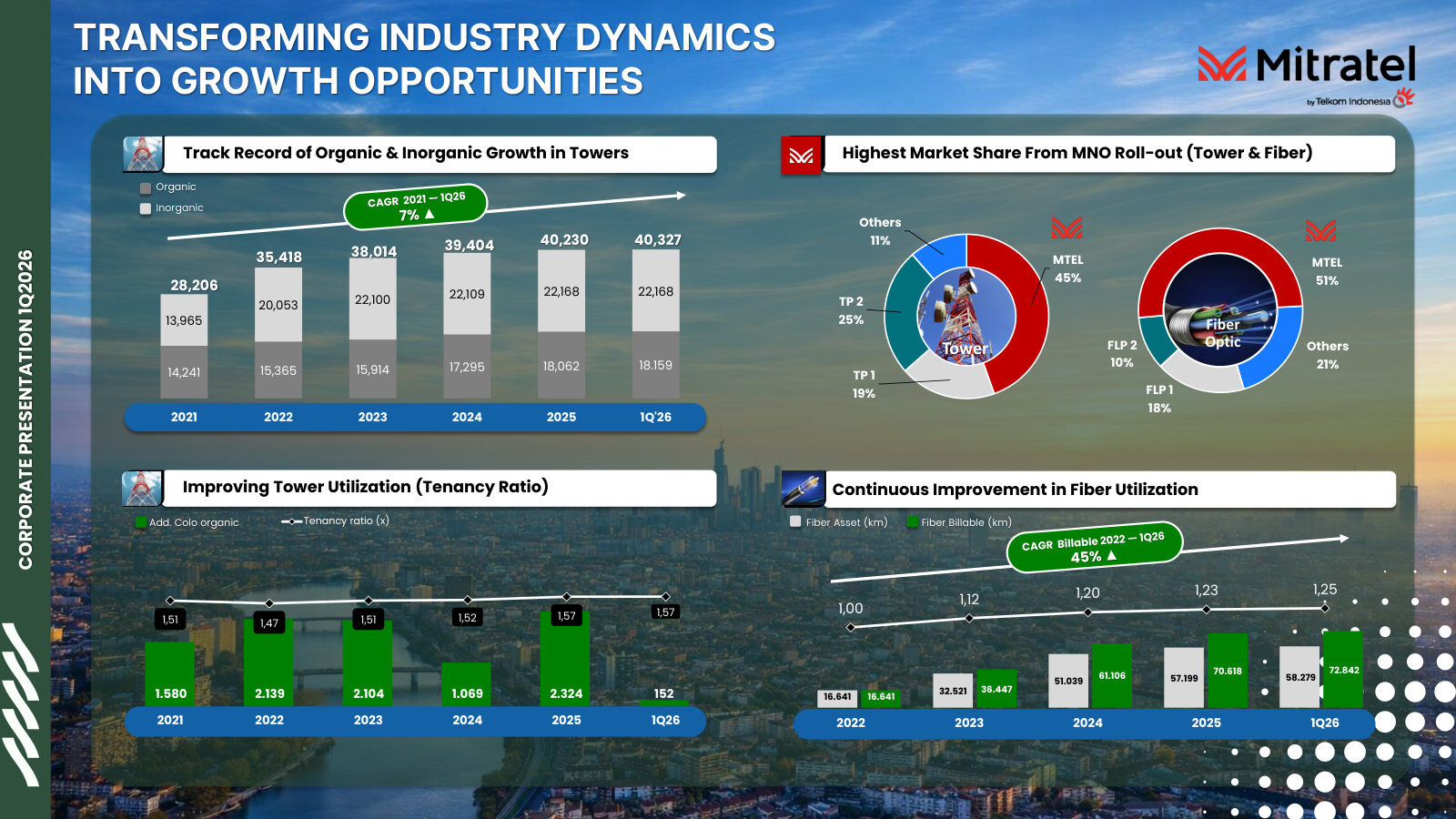
Mitratel's move beyond tower leasing into Power-as-a-Service — an attempt to lift revenue per tower and deepen MNO lock-in that stakes out 'Next-Gen TowerCo' ground TOWR would have to contest.
Power-as-a-Service (PaaS) reflects Mitratel's expansion beyond tower leasing through integrated energy solutions for telecom operators. Through PaaS, Mitratel strengthens its position as a Next-Gen TowerCo by supporting network expansion, operational efficiency, and sustainable connectivity across Indonesia.
p. 11 · Read in context →
PT Gihon Telekomunikasi Indonesia Tbk. (GHON)
A small pure-play Indonesian towerco leasing sites to the same cellular operators. Its value here is how a minor rival sizes the market TOWR leads — explicitly placing itself 'below the industry leader' — and how it frames the MNO-consolidation risk that reshapes tenancy demand for every tower operator.
Gihon benchmarks its 1.67x tenancy ratio against the Indonesian tower-leasing industry and concedes it sits 'below the industry leader' — an implicit nod to Protelindo's superior colocation density.
The Company’s tenancy ratio of 1.67x is in line with the industry average for the Indonesian tower leasing sector in 2025, which ranged between 1.60x and 1.75x. Compared to peers, this level is higher than several major players but still below the industry leader
p. 26 · Read in context →
Gihon's read on competitive intensity: the XL Axiata–Smartfren merger has 'further intensified competition and accelerated industry consolidation,' with market saturation risking pricing pressure and thinner margins across tower operators.
The telecommunications infrastructure industry remains highly dynamic and competitive. The recent merger between XL Axiata and Smartfren, forming XLSmart Telecom Sejahtera, has further intensified competition and accelerated industry consolidation. Slower market growth or market saturation may drive operators to compete aggressively for the same market share, potentially resulting in pricing pressure and reduced profit margins.
p. 39 · Read in context →
More peer documents
Q1_FY2026 — 16 pages · TBIG's latest release with its operating scale as a direct benchmark for Protelindo — 41,764 tenants, 24,666 sites and a 1.70x tenancy ratio, plus a note that Q1 net adds were still dented by XLSmart non-renewals. · Open →
Q3_FY2025 — 19 pages · More detail on XLSmart reconfiguring its network after the merger and the resulting non-renewals — the mechanics of the consolidation drag affecting all towercos. · Open →
Q2_FY2025 — 16 pages · First-half 2025 gross tenancy adds framed against 'the ongoing consolidation of our telecommunication customers' — a two-quarter read on the shared demand environment. · Open →
TBIG_annual_report_FY2024 — 391 pages · Prior-year market overview and customer/geographic mix (revenue split across Telkomsel, Indosat and XL; ~45% of revenue from outside Java-Bali) for a two-year view of the duopoly's footprint. · Open →
Q4_FY2025 — 14 pages · Mitratel's FY2025 deck with a higher 55% full-year tower wallet share and a wallet-share-by-MNO breakdown (Telkomsel, Indosat/IOH, XLSmart) that shows where rivals hold anchor positions. · Open →
Q3_FY2025 — 13 pages · Earlier deck confirming the market-share and tenancy-ratio claims are persistent quarter to quarter rather than a one-off. · Open →
Q2_FY2025 — 12 pages · Earliest Mitratel deck in the set, useful to trace the tower/fiber wallet-share and tenancy-ratio trend back through 2025. · Open →
GHON_annual_report_FY2024 — 165 pages · Gihon's prior-year risk section citing the Indosat-Hutchison merger as a precedent that cut tenancy ratios across tower providers — a concrete template for the XLSmart consolidation now underway. · Open →